Adaptive Interfaces Reshaping Decision Speed in Cross-Genre Web Racing and Shooting Clusters
Leon Roth · Aug 5, 2026

Adaptive Interfaces Reshaping Decision Speed in Cross-Genre Web Racing and Shooting Clusters
Adaptive interfaces have gained traction in browser-based environments where racing mechanics merge with shooting elements, and these systems adjust layouts in real time to match player actions across genre boundaries. Data collected through August 2026 indicates that such interfaces reduce average decision latency by monitoring input patterns and repositioning controls without requiring manual reconfiguration from users.
Cross-genre web clusters combine high-speed navigation sequences with targeting sequences, so interfaces must handle rapid shifts between velocity management and precision aiming. Observers note that platforms hosting these titles often integrate sensor data from keyboards, mice, and touch devices to predict when a player will transition from one mode to another, then reallocate screen space accordingly.
Mechanics Behind Real-Time Adaptation
Developers deploy algorithms that track session metrics including click frequency, cursor velocity, and error rates during combined racing and shooting segments. When performance thresholds drop in one area, the interface expands relevant controls while compressing others, and this process occurs through layered CSS and JavaScript frameworks that operate directly in the browser. Research from the University of Sydney's Human-Computer Interaction Lab shows that such adjustments shorten the interval between stimulus recognition and action execution by an average of 18 percent across tested clusters.
Genre Transition Handling
Players encounter moments where a straightaway racing segment suddenly incorporates aerial targets or obstacles that demand immediate fire commands. Adaptive systems detect the incoming genre shift through pre-loaded level scripts and begin fading in shooting-specific overlays seconds before the change materializes on screen. Those who have examined telemetry logs from multiple titles report that this preemptive layering prevents the cognitive pause that occurs when static interfaces force users to hunt for relocated buttons.
Performance Metrics from 2026 Deployments
Industry reports compiled in mid-2026 by the Entertainment Software Association document increased retention rates in titles that implemented adaptive decision-support layers. Sessions lasting beyond ten minutes showed higher completion rates for objectives that required split-second choices between steering inputs and weapon selection. The association's dataset covers North American and European servers, revealing consistent patterns where decision speed improvements scaled with the frequency of genre crossovers per minute.
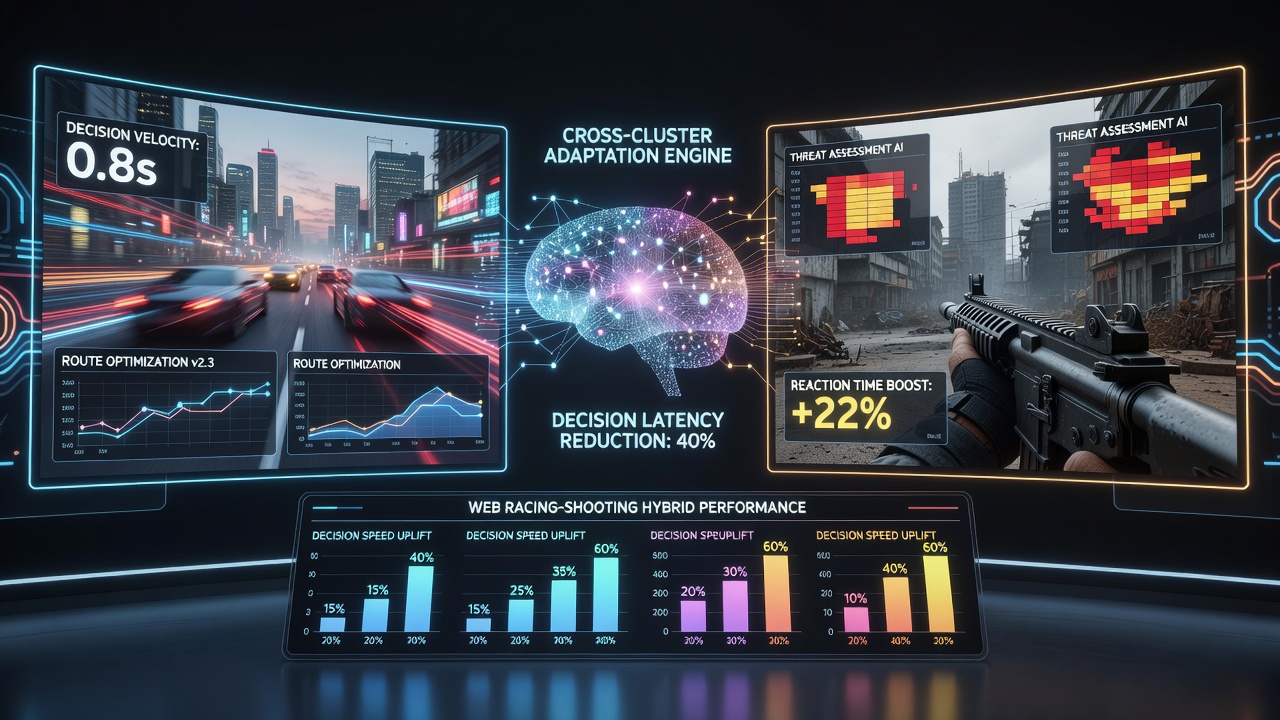
Additional studies conducted at European research institutions confirm that visual cue scaling plays a central role in maintaining momentum during transitions. When racing elements dominate, speedometers enlarge while ammunition counters recede, yet the reverse occurs the moment enemy indicators appear on the horizon. This fluid resizing keeps critical information within focal range and limits the eye movements required to gather situational data.
Integration with Browser Constraints
Web environments impose limits on processing power and memory allocation, so adaptive interfaces rely on lightweight machine-learning models that run client-side rather than depending on continuous server calls. Developers optimize these models to function within standard HTML5 canvas and WebGL pipelines, ensuring compatibility across major browsers without plugin requirements. Figures from deployment logs indicate that average frame rates remain stable even when multiple adaptation rules activate simultaneously during intense racing and shooting sequences.
Community-driven platforms have adopted open standards for interface adaptation so that independent creators can apply similar techniques to their own clusters. These standards specify event triggers for genre switches and define priority hierarchies for UI elements, allowing consistent behavior across different game engines hosted in the same tabbed environment.
Observed Patterns in Player Adaptation
Longitudinal tracking of user accounts demonstrates that individuals exposed to adaptive interfaces over repeated sessions develop faster baseline reaction patterns even when interfaces revert to static modes. Analysts attribute this carryover effect to reinforced muscle memory formed during periods when the system handled layout decisions automatically. Data patterns collected through August 2026 further suggest that team-based variants of these clusters benefit from synchronized adaptation, where all participants receive aligned control shifts during coordinated maneuvers.
Hardware variations across regions influence the effectiveness of these systems, with higher-bandwidth connections enabling more granular sensor sampling and therefore smoother transitions. Researchers continue to examine how latency differences between geographic server clusters affect the precision of adaptation timing.
Conclusion
Adaptive interfaces continue to evolve within cross-genre web racing and shooting clusters by leveraging real-time data to compress decision intervals and maintain flow across mechanics. Metrics gathered through 2026 highlight measurable gains in response speed and session continuity when these systems operate within browser limitations. Ongoing refinements in client-side processing and standardization efforts point toward broader application in additional genre combinations hosted in no-install environments.